Showing posts with label Social 30-1 Chapter 7 Test Study Guide. Show all posts

Friday, April 26, 2013

April 26


I delivered a lecture on the Clinton Administration today, which took most of the class period. I have posted this PowerPoint presentation and the George H.W. Bush presentation on the IB 30/35 wiki in the American Presidents section. We didn't have time to continue with the Clinton documentary today, and we won't on Monday either. If you wish to continue watching it, you can find a link to the PBS American Experience website on the Presidents.

You were given most of the period to work on your Chapter 8 Key Terms and Questions, which are due on Monday. Some of you used the time that you given very effectively, others not as much. Please remember that you have your Chapter 7 Cold War Exam on Monday, April 29th. you can find the study guide for this exam here (scroll down to find it). The Unit 2 Final Exam is on Thursday, May 2nd, please see the study guide here (scroll down to find it) .

I returned some homework checked work at the beginning of the class. We continued our film study of "Gandhi" today. We should be able to finish this film off on Monday. Please make sure that you are keeping up with the questions. This is your last weekend to work on your Unit 2 Research Project, which is due on Tuesday, April 30th.

Thursday, April 25, 2013

April 25


You were supposed to hand in your background information on India questions today. We started our film study of "Gandhi" today. I don't think that we'll be able to finish it off tomorrow. In all likelihood, we'll finish this film on Monday. Please remember that your Unit 2 Research Project is due on April 30th.


We finished watching "Good Night, and Good Luck" today. Your film study questions are due tomorrow. The film study for this is due on Thursday. "Good Night, and Good Luck" contains a few powerful scenes that I will post here on the blog.


This film explores a lot of issues that are relevant to today. You also have to understand the political climate at the time in the United States to fully understand the movie. Many Americans were drawn to communism in the 1930s due to the effects of the Great Depression, especially academics and those in the labour fields. In the movie they made reference to friends and spouses that had attended meetings long ago. The "Red Scare" caused a huge backlash against those sympathetic to communism or the USSR. Remember, during WWII the Soviet Union was an ally, and many people may have attended meetings out of curiosity. The junior Senator from Wisconsin, Joseph McCarthy in 1950 charged there were communist sympathizers in the U.S. State Department. Hearings were held, charges were discovered to be unfounded. McCarthy continued accusing communist infiltration in the Democratic Party. McCarthy became the chairman of the House Subcommittee on the investigation of un-American activity (HUAC). On December 2, 1954, McCarthy’s actions were called into question and his accusations were deemed unfounded. On Murrow's show "See it Now", he begins to publicly go after McCarthy. A very public feud develops when McCarthy responds by accusing Murrow of being a communist. Murrow is accused of having been a member of the leftist union Industrial Workers of the World, which Murrow claimed was false.
In this climate of fear and reprisal (which we now refer to as McCarthyism), the CBS crew carries on and their tenacity ultimately strikes a historic blow against McCarthy. Historical footage in the movie also shows the questioning of Annie Lee Moss, a Pentagon communication worker accused of being a communist based on her name appearing on a list seen by an FBI infiltrator of the American Communist Party. In the first half of the film Murrow talks about how McCarthy didn't create the political climate and anti-Communist hysteria sweeping the country, but that he capitalized on it for political gain very effectively. As David Strathairn (playing Murrow in the film says, "We will not walk in fear, one of another. We will not be driven by fear into an age of unreason if we dig deep in our history and doctrine and remember that we are not descended from fearful men, not from men who feared to write, to speak, to associate and to defend causes which were, for the moment, unpopular. We can deny our heritage and our history, but we cannot escape responsibility for the result. There is no way for a citizen of the Republic to abdicate responsibility.") The film is framed by the performance of the speech given by Murrow to the Radio and Television News Directors Association in 1958, in which Murrow harshly admonishes his audience not to squander the potential of television to inform and educate the public. I found this short video on YouTube that spliced together Edward R. Murrow's speech that appears at the beginning of the film and continues at the end of the film. I find that this speech has relevance even today when you talk about the level of discourse in the media.


Your Chapter 7 Test (The Cold War) is on Monday, April 29th, please see the study guide below. Your Unit 2 Final Exam is on Thursday, May 2nd, please see the study guide here.

It is a multiple choice test with 70-75 multiple choice questions. Please make sure that you have read Chapter 7. Here are some other study tips:

  • study "The Origins of the Cold War (ppt)"
  • study all notes on the Origins and Causes of the Cold War
  • study notes on the Korean War
  • study notes on the Cuban Missile Crisis
  • study notes on the Vietnam War (see notes package and Vietnam War booklet, and the notes that I sent to you on the Vietnam War)
  • make sure that you know all the Cold War Concepts
  • know the chronology of events of the Cold War (study the Cold War timeline and the Vietnam War timeline, and the end of the Cold War timeline that I will be giving you in subsequent class)
  • know key events that we've emphasized in class (for example: Berlin Airlift, Korean War, Cuban Missile Crisis, Vietnam War) plus other key events from the timeline
  • know major arms reduction agreements (bilateral agreements and multilateral agreements)
  • know about the formation of alliances (NATO, Warsaw Pact) and the formation of "spheres of influence"
  • anything that I gave you as a handout is testable material and should be reviewed!!
  • know how the Cold War ends and its results/consequences

We finished off the George H.W. Bush Administration today. I will post my PowerPoint lecture on the wiki tonight. We also started to watch part of the Clinton documentary from the American Experience series on "The Presidents". There's a link to these videos on the wiki in the American Presidents section. You'll probably have to watch these videos directly from the PBS website. I will try to lecture on the Clinton Administration tomorrow (if my voice holds out).

Wednesday, April 24, 2013

April 24


We started looking at the film "Good Night, and Good Luck" today in class. This film explores McCarthyism in the early 1950s. The film study that I provided you with also has a film review (if you are having a hard time understanding the film so far, it might be a good idea to read this over tonight), and some study questions and some discussion questions. This film definitely has relevance in today's world (which we'll be talking about more tomorrow and in Unit 3 of the course). Hopefully, we'll finish off the film tomorrow, and be able to have a short discussion period of some of the issues the film raises. In all likelihood, the study questions from the film study will be due on Monday. Please remember that you have your Chapter 7 Exam (Cold War Exam) on Monday, April 26th and your Unit 2 Final Exam on Thursday, April 29th. Please see the study guides for both exams here (scroll down to find the study guides).


I gave you a reading from Pulitzer Prize winning writer Samantha Power today. I would like you to read her article entitled "Never Again-The World's Most Unfulfilled Promise". I will also be sending you a PowerPoint presentation on other genocides that have occurred in the 20th century. We have now moved on to another topic in Unit 2, that being a case study of the Indian independence movement. I gave you a background reading booklet and a case study booklet. You were given the entire class period to complete the "Background and Colonial Period for India" section questions in the case study booklet. These questions will be due tomorrow. We'll begin our film study of "Gandhi" tomorrow.


We finished off the HBO documentary on Ronald Reagan today, and then we started looking at his successor George H.W. Bush.

Tuesday, April 23, 2013

April 23


I finished off the PowerPoint presentation on Ronald Reagan in class today, then we went down to Room 121 to watch an HBO documentary on Reagan.

We finished watching "Shake Hands with the Devil" today. Please remember that the film study questions are due tomorrow. Your Unit 2 Research Project is due on April 30th, one week from today.
We started tying up some loose ends with the Cold War today. We look at bilateral and multilateral disarmament agreements and treaties, and we also talked about key features of the post-Cold War world. I sent you some notes as well today, so please check your e-mail. Please remember that your Chapter 7 Cold War Exam is on Monday, April 29th. You can find the study guide for this exam below. Please also remember that your Unit 2 Final Exam is on Thursday, May 2nd; you can find the study guide for this exam below as well.

It is a multiple choice test with 70-75 multiple choice questions. Please make sure that you have read Chapter 7. Here are some other study tips:
  • study "The Origins of the Cold War (ppt)"
  • study all notes on the Origins and Causes of the Cold War
  • study notes on the Korean War
  • study notes on the Cuban Missile Crisis
  • study notes on the Vietnam War (see notes package and Vietnam War booklet, and the notes that I sent to you on the Vietnam War)
  • make sure that you know all the Cold War Concepts
  • know the chronology of events of the Cold War (study the Cold War timeline and the Vietnam War timeline, and the end of the Cold War timeline that I will be giving you in subsequent class)
  • know key events that we've emphasized in class (for example: Berlin Airlift, Korean War, Cuban Missile Crisis, Vietnam War) plus other key events from the timeline
  • know major arms reduction agreements (bilateral agreements and multilateral agreements), please study the notes that I will give you next week on this topic.
  • know about the formation of alliances (NATO, Warsaw Pact) and the formation of "spheres of influence"
  • anything that I gave you as a handout is testable material and should be reviewed!!
  • know how the Cold War ends and its results/consequences

    The Unit 2 Final Exam is on Thursday, May 2nd. It will be a 70-75 multiple choice question test. In your textbook, this is material from Chapters 3-8. Please look at the studying hints below:

    • study "The Development of Classical Liberalism" (ppt)
    • study "Responding to Classical Liberalism" (ppt)
    • study "The Evolution of Modern Liberalism" (ppt)
    • study "The Techniques of Dictatorship" (ppt)
    • study "20th Century Rejections of Modern Liberalism" (ppt)
    • study "The Origins of the Cold War" (ppt)
    • study the key concepts from the Chapters 3-8 worksheets
    • please see the summary notes from the Ideologies textbook: Chapter 7 (Private Enterprise)
    • supply-side economics
    • boom and bust cycle/business cycle
    • laws of supply and demand, Adam Smith, invisible hand, market forces
      self-interest, consumer sovereignty, competition, private ownership, profit motive
    • basic economic problems/questions
    • advantages/disadvantages of the market economy
    • causes of the Great Depression
    • FDR and the New Deal 
    • please see summary notes from the Ideologies textbook on the Mixed Economy Case Studies #14 (Sweden) and #15 (Canada), #16 (Japan), #17 (Fascism and Nazism)
    • also see the Democratic Socialism booklet on Sweden (indicative planning, "cradle to the grave" economics)
    • characteristics of a mixed economy
    • nationalization
    • privatization
    • democratic socialism
    • welfare capitalism
    • Keynesian economics
    • the business cycle and fiscal and monetary policies (study all of the notes I gave you and the booklet that I gave you)
    • demand-side economics
    • neo-conservatives
    • monetarism
    • trickle down economics
    • supply-side economics
    • Thatcherism and Reaganomics
    • Milton Friedman
    • Friedrich Hayek
    • how Keynesian economics deals with a recession (remember "the percolator": increase circulation of money reducing taxes, increase government spending on "make work" projects, and reduce interest rates, which according to Keynesian economics is going increase demand for goods and services and lead to more money circulating in the economy)
    • how supply-side economics deals with a recession (remember "trickle down coffee maker": government should stimulate the goods and services sector of the economy by reducing corporate and personal taxes, eventually benefits will "trickle down" to the middle class and working class, make connections between supply-side economics and laissez faire economics/classical liberalism)
    • advantages and disadvantages of a mixed economy
    • neo-conservative criticism of government intervention
    • characteristics of a centrally planned economy
    • advantages and disadvantages of a centrally planned economy
    • Marx notes (sent by e-mail)
    • Lenin notes (sent by e-mail)
    • establishment of the Soviet Union
    • Soviet economic system (top-down decision-making process)
    • Lenin's War Communism and the New Economic Policy
    • "Stalin and the Modernization of Russia" (see film notes)
    • Stalin notes (sent by e-mail)
    • "Changes to Soviet Society After Stalin" notes (this bridges the gap between Stalin and Gorbachev)
    • Gorbachev to Collapse Notes
    • Economic Planning in the USSR booklet
    • techniques of dictatorships (USSR and Nazi Germany case studies)
    • modern liberalism
    • features of the Nazi state
    • Hitler's rise to power
    • Characteristics of Democracy
    • Characteristics of Dictatorship
    • Democratic Systems notes
    • Non-Democratic Systems notes
    • Types of Dictatorships notes (includes Techniques of Dictatorships as well)
    • A Comparison of Communism and Fascism notes
    • Totalitarianism notes
    • Fascism/Nazism booklet (has techniques of dictatorship in Nazi Germany and USSR)
    • do a brief review of the political spectrum and economic spectrum and the quadrant model

    Monday, April 22, 2013

    April 22


    We picked up where Mr. Johnson left off last week. I covered the Ford and Carter administrations very quickly. I will post this presentation on the wiki. Make sure that you check out the sections in your Modern America, your IB History Companion textbook, and The United States and Its People textbook for more information on these two administrations. I also started the Reagan administration as well today.

    Most of today's class was spent watching the documentary film "Dear America: Letters Home from Vietnam". One week from today you will be writing your Chapter 7 Cold War Exam. Please see the study guide below. Your Unit 2 Final Exam is on Thursday, May 2nd. I will post the study guide for this exam later this week.


    It is a multiple choice test with 70-75 multiple choice questions. Please make sure that you have read Chapter 7. Here are some other study tips:
    • study "The Origins of the Cold War (ppt)"
    • study all notes on the Origins and Causes of the Cold War
    • study notes on the Korean War
    • study notes on the Cuban Missile Crisis
    • study notes on the Vietnam War (see notes package and Vietnam War booklet, and the notes that I sent to you on the Vietnam War)
    • make sure that you know all the Cold War Concepts
    • know the chronology of events of the Cold War (study the Cold War timeline and the Vietnam War timeline, and the end of the Cold War timeline that I will be giving you in subsequent class)
    • know key events that we've emphasized in class (for example: Berlin Airlift, Korean War, Cuban Missile Crisis, Vietnam War) plus other key events from the timeline
    • know major arms reduction agreements (bilateral agreements and multilateral agreements), please study the notes that I will give you next week on this topic.
    • know about the formation of alliances (NATO, Warsaw Pact) and the formation of "spheres of influence"
    • anything that I gave you as a handout is testable material and should be reviewed!!
    • know how the Cold War ends and its results/consequences

    We started our film study of "Shake Hands with the Devil". We should be able to finish off this video tomorrow. The film study questions are due on Wednesday, April 24th.

    Wednesday, November 16, 2011

    November 16

    We started our film study of 'Gandhi" today. We will continue this film tomorrow in class.

    Today was a work/study period. I gave you the Chapter 8 Worksheet, but I think that most of you opted to study for your Cold War Test which is tomorrow, please see the study guide here. Your Unit 2 Final Exam is on November 22nd, please see the study guide below.

    It will be a 75 multiple choice question test. In your textbook, this is material from Chapters 3-8. Please look at the studying hints below:

    • study "The Development of Classical Liberalism" (ppt)
    • study "Responding to Classical Liberalism" (ppt)
    • study "The Evolution of Modern Liberalism" (ppt)
    • study "The Techniques of Dictatorship" (ppt)
    • study "20th Century Rejections of Modern Liberalism" (ppt)
    • study "The Origins of the Cold War" (ppt)
    • study the key concepts from the Chapters 3-8 worksheets
    • please see the summary notes from the Ideologies textbook: Chapter 7 (Private Enterprise)
    • supply-side economics
    • boom and bust cycle/business cycle
    • laws of supply and demand, Adam Smith, invisible hand, market forces
      self-interest, consumer sovereignty, competition, private ownership, profit motive
    • basic economic problems/questions
    • advantages/disadvantages of the market economy
    • causes of the Great Depression
    • FDR and the New Deal
    • please see summary notes from the Ideologies textbook on the Mixed Economy Case Studies #14 (Sweden) and #15 (Canada), #16 (Japan), #17 (Fascism and Nazism)
    • also see the Democratic Socialism booklet on Sweden (indicative planning, "cradle to the grave" economics)
    • characteristics of a mixed economy
    • nationalization
    • privatization
    • democratic socialism
    • welfare capitalism
    • Keynesian economics
    • the business cycle and fiscal and monetary policies (study all of the notes I gave you and the booklet that I gave you)
    • demand-side economics
    • neo-conservatives
    • monetarism
    • trickle down economics
    • supply-side economics
    • Thatcherism and Reaganomics
    • Milton Friedman
    • Friedrich Hayek
    • how Keynesian economics deals with a recession (remember "the percolator": increase circulation of money reducing taxes, increase government spending on "make work" projects, and reduce interest rates, which according to Keynesian economics is going increase demand for goods and services and lead to more money circulating in the economy)
    • how supply-side economics deals with a recession (remember "trickle down coffee maker": government should stimulate the goods and services sector of the economy by reducing corporate and personal taxes, eventually benefits will "trickle down" to the middle class and working class, make connections between supply-side economics and laissez faire economics/classical liberalism)
    • advantages and disadvantages of a mixed economy
    • neo-conservative criticism of government intervention
    • characteristics of a centrally planned economy
    • advantages and disadvantages of a centrally planned economy
    • Marx notes (sent by e-mail)
    • Lenin notes (sent by e-mail)
    • establishment of the Soviet Union
    • Soviet economic system (top-down decision-making process)
    • Lenin's War Communism and the New Economic Policy
    • "Stalin and the Modernization of Russia" (see film notes)
    • Stalin notes (sent by e-mail)
    • "Changes to Soviet Society After Stalin" notes (this bridges the gap between Stalin and Gorbachev)
    • Gorbachev to Collapse Notes
    • Economic Planning in the USSR booklet
    • techniques of dictatorships (USSR and Nazi Germany case studies)
    • modern liberalism
    • features of the Nazi state
    • Hitler's rise to power
    • Characteristics of Democracy
    • Characteristics of Dictatorship
    • Democratic Systems notes
    • Non-Democratic Systems notes
    • Types of Dictatorships notes (includes Techniques of Dictatorships as well)
    • A Comparison of Communism and Fascism notes
    • Totalitarianism notes
    • Fascism/Nazism booklet (has techniques of dictatorship in Nazi Germany and USSR)
    • do a brief review of the political spectrum and economic spectrum and the quadrant model

    You wrote a cartoon analysis today for the first 20 minutes, and then I proceeded with the PowerPoint presentation on Canada and Latin America's role in WWI. I have posted this presentation on the wiki because you will need it for your matching quiz tomorrow. There are 39 key concepts in this matching quiz. We'll finish off discussing Latin America's role in WWI tomorrow.

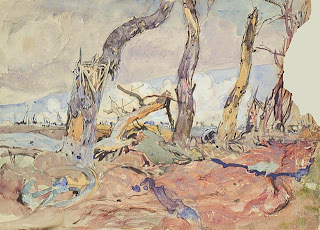
    I've mentioned this a few times in class, but I guess it's better late than never! Here is a link to a website that discusses J.R.R. Tolkien's experiences in the Great War, and how that influenced his writing of the Lord of the Rings trilogy, specifically the Journey through the Dead Marshes. The Great War was also a time when some of our most famous landscape artists came to the forefront, I'm referring to the Group of Seven, of course. Can you see some similarities in the pictures that I'm posting below?


    I guess my point is that art is based on personal experience, and these artists were heavily influenced by their experiences in the Great War.

    Tuesday, November 15, 2011

    November 15

    We went through the short presentations on the battlefield role of Canada and the United States in the First World War today. That was a lot of material to push through, so if you missed some of the details please check the charts out on the IB 30/35 Wiki (see link on the right hand side of the blog) under "Collaborative Notes". We'll be looking at the Battle of Passchendaele and the 100 Days tomorrow. Either on Wednesday or Thursday, expect to write a matching quiz on World War I. It covers key terms, key events, key people and key organizations in WWI, and it consists of 39 matching items. We should be getting into Latin America's role in the Great War by Thursday, and then proceed on to Woodrow Wilson's Fourteen Points and the Paris Peace Conference by Friday.

    We continued watching "Good Night, and Good Luck" today. The film study for this is due on Thursday. "Good Night, and Good Luck" contains a few powerful scenes that I will post here on the blog.


    This film explores a lot of issues that are relevant to today. You also have to understand the political climate at the time in the United States to fully understand the movie. Many Americans were drawn to communism in the 1930s due to the effects of the Great Depression, especially academics and those in the labour fields. In the movie they made reference to friends and spouses that had attended meetings long ago. The "Red Scare" caused a huge backlash against those sympathetic to communism or the USSR. Remember, during WWII the Soviet Union was an ally, and many people may have attended meetings out of curiosity. The junior Senator from Wisconsin, Joseph McCarthy in 1950 charged there were communist sympathizers in the U.S. State Department. Hearings were held, charges were discovered to be unfounded. McCarthy continued accusing communist infiltration in the Democratic Party. McCarthy became the chairman of the House Subcommittee on the investigation of un-American activity (HUAC). On December 2, 1954, McCarthy’s actions were called into question and his accusations were deemed unfounded. On Murrow's show "See it Now", he begins to publicly go after McCarthy. A very public feud develops when McCarthy responds by accusing Murrow of being a communist. Murrow is accused of having been a member of the leftist union Industrial Workers of the World, which Murrow claimed was false.
    In this climate of fear and reprisal (which we now refer to as McCarthyism), the CBS crew carries on and their tenacity ultimately strikes a historic blow against McCarthy. Historical footage in the movie also shows the questioning of Annie Lee Moss, a Pentagon communication worker accused of being a communist based on her name appearing on a list seen by an FBI infiltrator of the American Communist Party. In the first half of the film Murrow talks about how McCarthy didn't create the political climate and anti-Communist hysteria sweeping the country, but that he capitalized on it for political gain very effectively. As David Strathairn (playing Murrow in the film says, "We will not walk in fear, one of another. We will not be driven by fear into an age of unreason if we dig deep in our history and doctrine and remember that we are not descended from fearful men, not from men who feared to write, to speak, to associate and to defend causes which were, for the moment, unpopular. We can deny our heritage and our history, but we cannot escape responsibility for the result. There is no way for a citizen of the Republic to abdicate responsibility.") The film is framed by the performance of the speech given by Murrow to the Radio and Television News Directors Association in 1958, in which Murrow harshly admonishes his audience not to squander the potential of television to inform and educate the public. I found this short video on YouTube that spliced together Edward R. Murrow's speech that appears at the beginning of the film and continues at the end of the film. I find that this speech has relevance even today when you talk about the level of discourse in the media.


    Your Chapter 7 Test (The Cold War) is on November 17th, please see the study guide below.

    It is a multiple choice test with 70-75 multiple choice questions. Please make sure that you have read Chapter 7. Here are some other study tips:

    • study "The Origins of the Cold War (ppt)"
    • study all notes on the Origins and Causes of the Cold War
    • study notes on the Korean War
    • study notes on the Cuban Missile Crisis
    • study notes on the Vietnam War (see notes package and Vietnam War booklet, and the notes that I sent to you on the Vietnam War)
    • make sure that you know all the Cold War Concepts
    • know the chronology of events of the Cold War (study the Cold War timeline and the Vietnam War timeline, and the end of the Cold War timeline that I will be giving you in subsequent class)
    • know key events that we've emphasized in class (for example: Berlin Airlift, Korean War, Cuban Missile Crisis, Vietnam War) plus other key events from the timeline
    • know major arms reduction agreements (bilateral agreements and multilateral agreements)
    • know about the formation of alliances (NATO, Warsaw Pact) and the formation of "spheres of influence"
    • anything that I gave you as a handout is testable material and should be reviewed!!
    • know how the Cold War ends and its results/consequences
    Today was a work period in preparation for our film study of "Gandhi". You looked at a history reading of India, including colonial background information, and information on Hinduism and Islam. This information will be key to understanding of the movement to "home rule" for India that we will see in the film. Part 1 of the booklet is due tomorrow, this covers questions 1-4 in that section. Your Chapter 7-8 Test is on Thursday, November 24th, I will post the study guide for this test on November 17th. Your Unit 2 WRA I (3 Source Analysis) is on Friday, November 25th.

    Wednesday, November 9, 2011

    November 9

    We started an in-depth study of the Rwandan genocide by starting our film study of "Shake Hands with the Devil". Before we started the film you were to read over the other information in the film study booklet. You should be able to finish this film tomorrow in class.

    We finished some of the topics in the Cold War today, by looking at arms reduction talks and agreements, and by discussing trends that have emerged in the post-Cold War world. I also showed you a short YouTube video of all of the atomic tests/explosions since the Trinity test in 1945 to the late 1990s. Please re-read in the textbook the section on the Second Red scare and McCarthyism. Tomorrow, you'll start a film study on "Good Night, and Good Luck". It might be a good idea to check out this link on Edward R. Murrow as well.

    It is a multiple choice test with 70-75 multiple choice questions. Please make sure that you have read Chapter 7. Here are some other study tips:
    • study "The Origins of the Cold War (ppt)"
    • study all notes on the Origins and Causes of the Cold War
    • study notes on the Korean War
    • study notes on the Cuban Missile Crisis
    • study notes on the Vietnam War (see notes package and Vietnam War booklet, and the notes that I sent to you on the Vietnam War)
    • make sure that you know all the Cold War Concepts
    • know the chronology of events of the Cold War (study the Cold War timeline and the Vietnam War timeline, and the end of the Cold War timeline that I will be giving you in subsequent class)
    • know key events that we've emphasized in class (for example: Berlin Airlift, Korean War, Cuban Missile Crisis, Vietnam War) plus other key events from the timeline
    • know major arms reduction agreements (bilateral agreements and multilateral agreements), please study the notes that I will give you next week on this topic.
    • know about the formation of alliances (NATO, Warsaw Pact) and the formation of "spheres of influence"
    • anything that I gave you as a handout is testable material and should be reviewed!!
    • know how the Cold War ends and its results/consequences


    We continued our examination of the American role in World War I today, with me finishing off my PowerPoint lecture, and watching a short video on the Great War from an American perspective. Please remember that we are having the presentations on the Canadian and American battles in WWI on Tuesday. Make sure that you add your contributions on the wiki for your assigned battle in WWI by Remembrance Day.

    Monday, November 7, 2011

    November 7

    We continued looking at the First World War today. We watched a short video from the CBS Series on the Great War called "Clash of Generals". I finished the PowerPoint presentation that I started last week which covers some of the key battles of WWI and the end of the war. Remember, I've been going through the "big picture" of the Great War, and then tomorrow we'll start looking at the role of the United States in the war. I'll post the PowerPoint presentation on the wiki this afternoon.

    Today was a research period for your Unit 2 Research Project. This will be the only class period that you will have to do research. We'll set a due date for this project tomorrow in class.

    I did a homework check on the Southeast Asia package and the Cold War Events Notes booklet today in class. We watched a part of "Born on the Fourth of July" today as well. Please remember that your Chapter 7 Key Terms and Questions are due tomorrow. I gave you a booklet last week on the Vietnam War that contained the Vietnam War Assignment. This assignment is due on Wednesday. You are responsible for the A-C sections on the front page with this assignment (please see below).
    A. PEOPLE
    Identify and explain the role each played in the Vietnam War
    1. Ho Chi Minh
    2. Ngo Dinh Diem
    3. Lyndon B. Johnson
    4. Richard M. Nixon
    5. Viet Minh
    6. Viet Cong
    7. Le Duc Tho
    8. Henry Kissinger
    9. William Westmoreland
    10. "Draft Dodger"

    B. CONCEPTS/TERMS
    Explain the significance of the following with regards to the Vietnam War (identify participants or individuals if appropriate)
    1. Ho Chi Minh Trail
    2. defoliation
    3. "search and destroy" mission
    4. "Vietnamization of the war"
    5. Gulf of Tonkin Incident
    6. My Lai Massacre
    7. domino theory
    8. Kent State University protest (May 4, 1970)
    9. Tet Offensive (January 1968)
    10. Geneva Agreement (1954)

    C. ISSUES
    Provide the information requested
    1. The predominant religion of Vietnam
    2. The battle which marked the end of French colonial rule in Indo-China
    3. The scandal which led to the only resignation of an American President
    4. The Vice President who replaced the President after his resignation
    5. Why was November 1963 a "bad month" for the governments of South Vietnam and the United States?

    As we will see, public support for the Vietnam War changes over time as more and more American soldiers are killed. We see a growth in the anti-Vietnam War demonstrations, and the media also played a role in the turn of popular opinion against the war. I REALLY recommend that you have a look at the this series of photographs from the Vietnam War era, pretty powerful imagery (make sure that you read the captions too). Here is a link to the NPR that explains the story behind the photograph below, definitely worth the time to read or listen to the podcast, and make sure that you look at the photo gallery of Eddie Adams' photographs of the Vietnam War.


    There are certain iconic images associated with the Vietnam War. Here is another:

    The above photograph is of Phan Thị Kim Phúc, O.Ont (born in 1963), she is a Vietnamese-Canadian best known as the child subject of a Pulitzer Prize winning photograph taken during the Vietnam War on June 8, 1972. The iconic photo taken in Trang Bang by AP photographer Nick Ut shows her at about age nine running naked on the street after being severely burned on her back by a South Vietnamese napalm attack. Contrary to popular myth, the US Air Force were not involved in the attack, and only two US troops were within 60 miles (97 km) of the scene, neither of whom had any say in the bombings. Still, it is a powerful image associated with the war.

    I'm posting the study guide for your Chapter 7 Test (Cold War Exam) below. You have a lot of review and studying to do, that's why I'm posting this study guide so far in advance (this test is on November 17th).

    It is a multiple choice test with 70-75 multiple choice questions. Please make sure that you have read Chapter 7. Here are some other study tips:
    • study "The Origins of the Cold War (ppt)"
    • study all notes on the Origins and Causes of the Cold War
    • study notes on the Korean War
    • study notes on the Cuban Missile Crisis
    • study notes on the Vietnam War (see notes package and Vietnam War booklet, and the notes that I sent to you on the Vietnam War)
    • make sure that you know all the Cold War Concepts
    • know the chronology of events of the Cold War (study the Cold War timeline and the Vietnam War timeline, and the end of the Cold War timeline that I will be giving you in subsequent class)
    • know key events that we've emphasized in class (for example: Berlin Airlift, Korean War, Cuban Missile Crisis, Vietnam War) plus other key events from the timeline
    • know major arms reduction agreements (bilateral agreements and multilateral agreements), please study the notes that I will give you next week on this topic.
    • know about the formation of alliances (NATO, Warsaw Pact) and the formation of "spheres of influence"
    • anything that I gave you as a handout is testable material and should be reviewed!!
    • know how the Cold War ends and its results/consequences

    Thursday, April 21, 2011

    April 21

    We finished watching "Good Night, and Good Luck" today in class. This film explores a lot of issues that are relevant to today. You also have to understand the political climate at the time in the United States to fully understand the movie. Many Americans were drawn to communism in the 1930s due to the effects of the Great Depression, especially academics and those in the labour fields. In the movie they made reference to friends and spouses that had attended meetings long ago. The "Red Scare" caused a huge backlash against those sympathetic to communism or the USSR. Remember, during WWII the Soviet Union was an ally, and many people may have attended meetings out of curiosity. The junior Senator from Wisconsin, Joseph McCarthy in 1950 charged there were communist sympathizers in the U.S. State Department. Hearings were held, charges were discovered to be unfounded. McCarthy continued accusing communist infiltration in the Democratic Party. McCarthy became the chairman of the House Subcommittee on the investigation of un-American activity (HUAC). On December 2, 1954, McCarthy’s actions were called into question and his accusations were deemed unfounded. On Murrow's show "See it Now", he begins to publicly go after McCarthy. A very public feud develops when McCarthy responds by accusing Murrow of being a communist. Murrow is accused of having been a member of the leftist union Industrial Workers of the World, which Murrow claimed was false.
    In this climate of fear and reprisal (which we now refer to as McCarthyism), the CBS crew carries on and their tenacity ultimately strikes a historic blow against McCarthy. Historical footage in the movie also shows the questioning of Annie Lee Moss, a Pentagon communication worker accused of being a communist based on her name appearing on a list seen by an FBI infiltrator of the American Communist Party. In the first half of the film Murrow talks about how McCarthy didn't create the political climate and anti-Communist hysteria sweeping the country, but that he capitalized on it for political gain very effectively. As David Strathairn (playing Murrow in the film says, "We will not walk in fear, one of another. We will not be driven by fear into an age of unreason if we dig deep in our history and doctrine and remember that we are not descended from fearful men, not from men who feared to write, to speak, to associate and to defend causes which were, for the moment, unpopular. We can deny our heritage and our history, but we cannot escape responsibility for the result. There is no way for a citizen of the Republic to abdicate responsibility." The film is framed by the performance of the speech given by Murrow to the Radio and Television News Directors Association in 1958, in which Murrow harshly admonishes his audience not to squander the potential of television to inform and educate the public. I found this short video on YouTube that spliced together Edward R. Murrow's speech that appears at the beginning of the film and continues at the end of the film. I find that this speech has relevance even today when you talk about the level of discourse in the media. Your film study for "Good Night and Good Luck" is due on Monday, April 25th. We also did a quick review of Soviet and American leaders during the Cold War, so if you missed class today, please get these notes from a classmate. I also gave you a handout called "The End of the Cold War". Please remember that you have your Chapter 7 Test (Cold War period) on Monday, April 25th (here is the study guide-scroll down to find it) and your Unit 2 Final Exam on April 27th (Wednesday), please see the study guide here.


    We finished off "The Expansion of Economic Globalization" PowerPoint presentation today. I will be sending this presentation to you this afternoon. I also gave back the results of your Unit 2 Final Exam. I gave you a booklet that examined the WTO, the IMF, and the World Bank. You have a homework assignment that is due on Monday on the WTO. For Monday, you must create a WTO chart (a T-chart) with advantages and disadvantages of the WTO system. You are to "back up" your statements in your WTO chart (for example, don't simply put "The WTO is killing people", that's a statement that requires clarification) You might want to check out this link to criticisms of the WTO. Your Chapter 10-11 Test is on Monday, May 2nd, so I will be posting a study guide one week in advance (April 25th).

    Wednesday, April 20, 2011

    April 20


    We started looking at the film "Good Night, and Good Luck" today in class. This film explores McCarthyism in the early 1950s. The film study that I provided you with also has a film review, and some study questions and some discussion questions. This film definitely has relevance in today's world (which we'll be talking about more tomorrow and in Unit 3 of the course). Hopefully, we'll finish off the film tomorrow, and be able to have a short discussion period of some of the issues the film raises. In all likelihood, the study questions from the film study will be due on Monday. Please remember that you have your Chapter 7 Exam (Cold War Exam) on Monday, April 25th and your Unit 2 Final Exam on Wednesday, April 27th.


    In all likelihood, I will start with this speech in the film in tomorrow's class.

    I did a homework check on your Chapter 10 Questions today. Your Chapter 11 Key Terms are due tomorrow. You wrote your Unit 2 Final Exam today, which took most of the period. You will get the results of this test back tomorrow.

    Tuesday, April 19, 2011

    April 19

    We started a PowerPoint lecture today called "The Expansion of Economic Globalization", which we will finish on Thursday. Tomorrow, you have your Unit 2 Final Exam, here is the study guide. If you didn't hand in your Chapter 10 Questions today, please make sure that you have it ready for tomorrow. Your Chapter 11 Key Terms are due on Thursday, April 21st.

    I gave you some notes on arms reduction talks, specifically on bilateral agreements between the USSR and the USA, and multilateral agreements on arms reduction. I also gave you a booklet that covered the same topic. I showed you a National Geographic video called "Inside North Korea", to show you the legacies of the Cold War in the world today. I also did a homework check on your Vietnam War Assignment. Your Chapter 7 Test is on Monday, April 25th, please see the study guide here (scroll down to find it). I also posted the study guide for your Unit 2 Final Exam, so please find the study guide here (scroll down to find it).

    Monday, April 18, 2011

    April 18

    I gave you back your Unit 2 WRA I at the beginning of class today. I will do a workshop on this writing assignment in tutorial on Wednesday. I then showed you a short video from an Australian TV show called "Dateline". This video focused in on "China's Ghost Cities". Building massive cities is one way in which the Chinese government is able to provide jobs and continue maintain GDP growth. You can watch the video here, or have a look at these cities from satellite images as well. We were also able to have a short four corner debate on genetically modified foods from the "Dilemmas of Global Trade" sheet that I gave you on Friday. Your Unit 2 Final Exam is on Wednesday, please see the study guide here.


    I did a homework check on your Chapter 7 Key Terms at the beginning of class today. We watched the documentary film "Dear America: Letters Home from Vietnam" for most of the period. Here is the link to your Chapter 7 Test (The Cold War), this test is on Monday, April 25th. You'll have to scroll down to find the Chapter 7 Test Study Guide. Your Unit 2 Final Exam is on Wednesday, April 27th, please see the study guide below.


    The Unit 2 Final Exam is on Wednesday, April 27th. It will be a 75 multiple choice question test. In your textbook, this is material from Chapters 3-8. Please look at the studying hints below:

    • study "The Development of Classical Liberalism" (ppt)
    • study "Responding to Classical Liberalism" (ppt)
    • study "The Evolution of Modern Liberalism" (ppt)
    • study "The Techniques of Dictatorship" (ppt)
    • study "20th Century Rejections of Modern Liberalism" (ppt)
    • study "The Origins of the Cold War" (ppt)
    • study the key concepts from the Chapters 3-8 worksheets
    • please see the summary notes from the Ideologies textbook: Chapter 7 (Private Enterprise)
    • supply-side economics
    • boom and bust cycle/business cycle
    • laws of supply and demand, Adam Smith, invisible hand, market forces
      self-interest, consumer sovereignty, competition, private ownership, profit motive
    • basic economic problems/questions
    • advantages/disadvantages of the market economy
    • causes of the Great Depression
    • FDR and the New Deal
    • please see summary notes from the Ideologies textbook on the Mixed Economy Case Studies #14 (Sweden) and #15 (Canada), #16 (Japan), #17 (Fascism and Nazism)
    • also see the Democratic Socialism booklet on Sweden (indicative planning, "cradle to the grave" economics)
    • characteristics of a mixed economy
    • nationalization
    • privatization
    • democratic socialism
    • welfare capitalism
    • Keynesian economics
    • the business cycle and fiscal and monetary policies (study all of the notes I gave you and the booklet that I gave you)
    • demand-side economics
    • neo-conservatives
    • monetarism
    • trickle down economics
    • supply-side economics
    • Thatcherism and Reaganomics
    • Milton Friedman
    • Friedrich Hayek
    • how Keynesian economics deals with a recession (remember "the percolator": increase circulation of money reducing taxes, increase government spending on "make work" projects, and reduce interest rates, which according to Keynesian economics is going increase demand for goods and services and lead to more money circulating in the economy)
    • how supply-side economics deals with a recession (remember "trickle down coffee maker": government should stimulate the goods and services sector of the economy by reducing corporate and personal taxes, eventually benefits will "trickle down" to the middle class and working class, make connections between supply-side economics and laissez faire economics/classical liberalism)
    • advantages and disadvantages of a mixed economy
    • neo-conservative criticism of government intervention
    • characteristics of a centrally planned economy
    • advantages and disadvantages of a centrally planned economy
    • Marx notes (sent by e-mail)
    • Lenin notes (sent by e-mail)
    • establishment of the Soviet Union
    • Soviet economic system (top-down decision-making process)
    • Lenin's War Communism and the New Economic Policy
    • "Stalin and the Modernization of Russia" (see film notes)
    • Stalin notes (sent by e-mail)
    • "Changes to Soviet Society After Stalin" notes (this bridges the gap between Stalin and Gorbachev)
    • Gorbachev to Collapse Notes
    • Economic Planning in the USSR booklet
    • techniques of dictatorships (USSR and Nazi Germany case studies)
    • modern liberalism
    • features of the Nazi state
    • Hitler's rise to power
    • Characteristics of Democracy
    • Characteristics of Dictatorship
    • Democratic Systems notes
    • Non-Democratic Systems notes
    • Types of Dictatorships notes (includes Techniques of Dictatorships as well)
    • A Comparison of Communism and Fascism notes
    • Totalitarianism notes
    • Fascism/Nazism booklet (has techniques of dictatorship in Nazi Germany and USSR)
    • do a brief review of the political spectrum and economic spectrum and the quadrant model

    Friday, April 15, 2011

    April 15

    I collected your Chapter 10 Key Terms today in class. We watched part of the China Rises series called "Getting Rich". As you watched this documentary you were to complete film study questions. Information that you collected during this video could be useful on an upcoming essay if you used China as a case study of the positives or the negatives of economic globalization. If you missed class today, please make sure that you pick up the film study and get the notes from a classmate. Here is a hyperlink to the China Rises website, which could be useful for your study. I also gave you a handout called "Dilemmas of Global Trade" which I would like you to have read prior to Monday's class. We will be discussing the issues raised in this handout. I recommend that you also rank your top 3 or 4 choices of scenarios that you would like to discuss in class. Please remember that your Unit 2 Final Exam is on Wednesday, April 20th. Please see the study guide here for this very important exam.
    We continued our look at the Vietnam War. I gave you a couple of key handouts on the Vietnam War that you MUST read before Monday's class. I gave you a booklet on the Vietnam War that contained the Vietnam War Assignment. This assignment is due on Tuesday. You are responsible for the A-C sections on the front page with this assignment (please see below).
    A. PEOPLE
    Identify and explain the role each played in the Vietnam War
    1. Ho Chi Minh
    2. Ngo Dinh Diem
    3. Lyndon B. Johnson
    4. Richard M. Nixon
    5. Viet Minh
    6. Viet Cong
    7. Le Duc Tho
    8. Henry Kissinger
    9. William Westmoreland
    10. "Draft Dodger"

    B. CONCEPTS/TERMS
    Explain the significance of the following with regards to the Vietnam War (identify participants or individuals if appropriate)
    1. Ho Chi Minh Trail
    2. defoliation
    3. "search and destroy" mission
    4. "Vietnamization of the war"
    5. Gulf of Tonkin Incident
    6. My Lai Massacre
    7. domino theory
    8. Kent State University protest (May 4, 1970)
    9. Tet Offensive (January 1968)
    10. Geneva Agreement (1954)

    C. ISSUES
    Provide the information requested
    1. The predominant religion of Vietnam
    2. The battle which marked the end of French colonial rule in Indo-China
    3. The scandal which led to the only resignation of an American President
    4. The Vice President who replaced the President after his resignation
    5. Why was November 1963 a "bad month" for the governments of South Vietnam and the United States?

    I also gave you a booklet that outlined the Tonkin Gulf Resolution, as well as having a graph with the number of American soldiers in Vietnam, as well as the number of deaths in the conflict. As we will see, public support for the Vietnam War changes over time as more and more American soldiers are killed. We see a growth in the anti-Vietnam War demonstrations, and the media also played a role in the turn of popular opinion against the war. I REALLY recommend that you have a look at the this series of photographs from the Vietnam War era, pretty powerful imagery (make sure that you read the captions too). Here is a link to the NPR that explains the story behind the photograph below, definitely worth the time to read or listen to the podcast, and make sure that you look at the photo gallery of Eddie Adams' photographs of the Vietnam War.


    There are certain iconic images associated with the Vietnam War. Here is another:

    The above photograph is of Phan Thị Kim Phúc, O.Ont (born in 1963), she is a Vietnamese-Canadian best known as the child subject of a Pulitzer Prize winning photograph taken during the Vietnam War on June 8, 1972. The iconic photo taken in Trang Bang by AP photographer Nick Ut shows her at about age nine running naked on the street after being severely burned on her back by a South Vietnamese napalm attack. Contrary to popular myth, the US Air Force were not involved in the attack, and only two US troops were within 60 miles (97 km) of the scene, neither of whom had any say in the bombings. Still, it is a powerful image associated with the war.
    I'm posting the study guide for your Chapter 7 Test (Cold War Exam) below. You have a lot of review and studying to do, that's why I'm posting this study guide so far in advance (this test is on Monday, April 25th).

    It is a multiple choice test with 70-75 multiple choice questions. Please make sure that you have read Chapter 7. Here are some other study tips:
    • study "The Origins of the Cold War (ppt)"
    • study all notes on the Origins and Causes of the Cold War
    • study notes on the Korean War
    • study notes on the Cuban Missile Crisis
    • study notes on the Vietnam War (see notes package and Vietnam War booklet, and the notes that I sent to you on the Vietnam War)
    • make sure that you know all the Cold War Concepts
    • know the chronology of events of the Cold War (study the Cold War timeline and the Vietnam War timeline, and the end of the Cold War timeline that I will be giving you in subsequent class)
    • know key events that we've emphasized in class (for example: Berlin Airlift, Korean War, Cuban Missile Crisis, Vietnam War) plus other key events from the timeline
    • know major arms reduction agreements (bilateral agreements and multilateral agreements), please study the notes that I will give you next week on this topic.
    • know about the formation of alliances (NATO, Warsaw Pact) and the formation of "spheres of influence"
    • anything that I gave you as a handout is testable material and should be reviewed!!
    • know how the Cold War ends and its results/consequences

    Wednesday, November 17, 2010

    November 17

    I went through a PowerPoint presentation today called "Contemporary Examples of Genocide" and I also gave you a reading package on many of the same genocides of the 20th century. I will be sending this presentation to you this afternoon. It is still recommended that you print these PowerPoint presentations off (4-6 slides per page) and add them to your notes. I also gave you reading by Samantha Power, author of the Pulitzer Prize-winning book A Problem from Hell: America in the Age of Genocide, the reading that I gave you was called "Never Again: The World's Most Unfulfilled Promise". Tomorrow we'll begin to look at background information on India in preparation for our film study of Gandhi. I gave you some class time to read over this booklet. Please remember the following upcoming important dates:

    • Chapter 7 Key Terms and Questions are due on Monday, November 22nd
    • Chapter 8 Key Terms and Questions are due on Wednesday, November 24th
    • Unit 2 Research Project is due on Monday, November 29th


    We finished watching "Good Night, and Good Luck" today in class. This film explores a lot of issues that are relevant to today. You also have to understand the political climate at the time in the United States to fully understand the movie. Many Americans were drawn to communism in the 1930s due to the effects of the Great Depression, especially academics and those in the labour fields. In the movie they made reference to friends and spouses that had attended meetings long ago. The "Red Scare" caused a huge backlash against those sympathetic to communism or the USSR. Remember, during WWII the Soviet Union was an ally, and many people may have attended meetings out of curiosity. The junior Senator from Wisconsin, Joseph McCarthy in 1950 charged there were communist sympathizers in the U.S. State Department. Hearings were held, charges were found to be unfounded. McCarthy continued accusing communist infiltration in the Democratic Party. McCarthy became the chairman of the House Subcommittee on the investigation of un-American activity (HUAC). On December 2, 1954, McCarthy’s actions were called into question and his accusations were deemed unfounded. Murrow makes a show on McCarthy attacking him. A very public feud develops when McCarthy responds by accusing Murrow of being a communist. Murrow is accused of having been a member of the leftist union Industrial Workers of the World, which Murrow claimed was false.
    In this climate of fear and reprisal (which we now refer to as McCarthyism), the CBS crew carries on and their tenacity ultimately strikes a historic blow against McCarthy. Historical footage in the movie also shows the questioning of Annie Lee Moss, a Pentagon communication worker accused of being a communist based on her name appearing on a list seen by an FBI infiltrator of the American Communist Party. In the first half of the film Murrow talks about how McCarthy didn't create the political climate and anti-Communist hysteria sweeping the country, but that he capitalized on it for political gain very effectively. As David Strathairn (playing Murrow in the film says, "We will not walk in fear, one of another. We will not be driven by fear into an age of unreason if we dig deep in our history and doctrine and remember that we are not descended from fearful men, not from men who feared to write, to speak, to associate and to defend causes which were, for the moment, unpopular. We can deny our heritage and our history, but we cannot escape responsibility for the result. There is no way for a citizen of the Republic to abdicate responsibility." The film is framed by the performance of the speech given by Murrow to the Radio and Television News Directors Association in 1958, in which Murrow harshly admonishes his audience not to squander the potential of television to inform and educate the public. I found this short video on YouTube that spliced together Edward R. Murrow's speech that appears at the beginning of the film and continues at the end of the film. I find that this speech has relevance even today when you talk about the level of discourse in the media. Your film study for "Good Night and Good Luck" is due on Friday. We also did a quick review of Cold War concepts, if you missed class today, please get these notes from a classmate. Please remember that you have your Chapter 7 Test (Cold War period) tomorrow and your Unit 2 Final Exam on Tuesday. Please see both study guides here.

    Tuesday, November 16, 2010

    November 16


    We started looking at the film "Good Night, and Good Luck" today in class. This film explores McCarthyism in the early 1950s. The film study that I provided you with also has a film review (if you are having a hard time understanding the film so far, it might be a good idea to read this over tonight), and some study questions and some discussion questions. This film definitely has relevance in today's world (which we'll be talking about more tomorrow and in Unit 3 of the course). Hopefully, we'll finish off the film tomorrow, and be able to have a short discussion period of some of the issues the film raises. In all likelihood, the study questions from the film study will be due on Monday. Please remember that you have your Chapter 7 Exam (Cold War Exam) on Thursday, November 18th and your Unit 2 Final Exam on Tuesday, November 23rd. You can find both study guides here (scroll down to find them).


    We finished watching "Shake Hands with the Devil" today in class. The pre-viewing and post-viewing questions from the "Shake Hands with the Devil" film study are due tomorrow. Here is some additional information on Theoneste Bagosora (especially useful if your Unit 2 Research Project is on the Rwandan genocide). We will look at other contemporary examples of genocide tomorrow, and look at an article written by Samantha Power on the subject. Later this week, we'll start looking at India, the Indian independence movement, and the civil disobedience and non-violence movement advocated by Gandhi.

    Monday, November 15, 2010

    November 15


    We watched a video called "Inside North Korea" to look at one of the legacies of the Cold War. The Korean peninsula is still divided to this day, and it's important to see how Kim Jong-Il maintains power in North Korea. Hopefully you could see the techniques of dictatorship at work in the video. Please make sure that you study for the Cold War Exam (Chapter 7), please see the study guide here (scroll down to find it). You also have your Unit 2 Final Exam coming up as well, here's the study guide here (scroll down to find it). Tomorrow, we'll be starting a film study on "Good Night and Good Luck". We will be looking at McCarthyism in the United States in the 1950s (so we're backtracking a bit). To fully understand what we're doing in class on Tuesday and Wednesday, it will be beneficial to re-read the section in Perspectives on Ideology on McCarthyism and to read up on Edward R. Murrow as well.


    We finished watching "Scream Bloody Murder" today, and as you watched this video you were to take notes on the various genocides depicted. We also moved on to our film study of "Shake Hands with the Devil" today. We will finish this movie tomorrow, and then I will talk about when the film study is due. Your Chapter 7 Key Terms and Questions are due on Monday, November 22nd. Your Unit 2 Project is due on Tuesday, November 23rd.

    Wednesday, November 10, 2010

    November 10


    Today was a shorter period due to the Remembrance Day ceremony, but we started watching CNN Presents "Scream Bloody Murder". We'll finish this video on Monday. Over this weekend, you should be working on your Unit 2 Research Projects. This project is due on Tuesday, November 23rd. Here is a link to CNN Presents: Scream Bloody Murder (this video is on YouTube, but it's split into 14 parts! You can check it out here.) Here is a profile of Romeo Dallaire as well: In-Depth Profile of Romeo Dallaire from CBC News. We'll be looking at the Rwandan Genocide next week, so it might help get an idea of the man at the center of UN mission in Rwanda.

    Social 20-1 Students: Check Your E-Mail!


    Today was a very short 50 minute period. We looked briefly at disarmament talks during the Cold War. I put notes up on the board on bilateral and multilateral agreements aimed at disarmament. If you missed class today, you need to get these notes from a classmate. We also looked at the end of the Cold War era and global trends since the end of the Cold War. Here is the link to the Chapter 7 Test Study Guide (it's on Thursday, November 18th) and a link to the Unit 2 Final Exam (which is on Tuesday, November 23rd). Also, you have your Unit 2 WRA II (Essay) on Monday, November 29th. I did a homework check on your Vietnam War Assignment today as well. I'm almost forgot to post this video of nuclear bomb testing around the world that I promised in class on Friday, have a look it's only 5 minutes long. It's a bit shocking to see all of these tests! It also only covers 1945 to 1998, and there have been more countries that have joined the "nuclear club" since then.

    Tuesday, November 9, 2010

    November 9


    We watched "Dear America: Letters Home From Vietnam" today in class. I also gave you a package on the causes of the Vietnam War and key phases of the war. Make sure that you read it! Your Vietnam War assignment is due tomorrow. Please see yesterday's post for the study guides for the Chapter 7 Test (Cold War) and the Unit 2 Final Exam. Tomorrow, your Vietnam War Assignment is due (sections A-C). If you missed the handout, here are the topics that need to be covered in the Vietnam War Assignment:


    A. PEOPLE
    Identify and explain the role each played in the Vietnam War
    1. Ho Chi Minh
    2. Ngo Dinh Diem
    3. Lyndon B. Johnson
    4. Richard M. Nixon
    5. Viet Minh
    6. Viet Cong
    7. Le Duc Tho
    8. Henry Kissinger
    9. William Westmoreland
    10. "Draft Dodger"

    B. CONCEPTS/TERMS
    Explain the significance of the following with regards to the Vietnam War (identify participants or individuals if appropriate)
    1. Ho Chi Minh Trail
    2. defoliation
    3. "search and destroy" mission
    4. "Vietnamization of the war"
    5. Gulf of Tonkin Incident
    6. My Lai Massacre
    7. domino theory
    8. Kent State University protest (May 4, 1970)
    9. Tet Offensive (January 1968)
    10. Geneva Agreement (1954)

    C. ISSUES
    Provide the information requested
    1. The predominant religion of Vietnam
    2. The battle which marked the end of French colonial rule in Indo-China
    3. The scandal which led to the only resignation of an American President
    4. The Vice President who replaced the President after his resignation
    5. Why was November 1963 a "bad month" for the governments of South Vietnam and the United States?


    You had today to work on your Unit 2 Research Projects. This will be the only library class time that you will get. This project is due on Tuesday, November 23rd. This gives you two weeks and, more importantly, two weekends to put the project together.

    Monday, November 8, 2010

    November 8


    We continued our look at the Vietnam War today by watching an excerpt from "Born of the Fourth of July". Please Here is a link to the NPR that explains the story behind this photograph, definitely worth the time to read or listen to the podcast, and make sure that you look at the photo gallery of Eddie Adams' photographs of the Vietnam War.


    There are certain iconic images associated with the Vietnam War. Here is another:

    The above photograph is of Phan Thị Kim Phúc, O.Ont (born in 1963), she is a Vietnamese-Canadian best known as the child subject of a Pulitzer Prize winning photograph taken during the Vietnam War on June 8, 1972. The iconic photo taken in Trang Bang by AP photographer Nick Ut shows her at about age nine running naked on the street after being severely burned on her back by a South Vietnamese napalm attack. Contrary to popular myth, the US Air Force were not involved in the attack, and only two US troops were within 60 miles (97 km) of the scene, neither of whom had any say in the bombings. Still, it is a powerful image associated with the war.

    Your Vietnam War Assignment is due on Wednesday.

    I'm posting study guides for your Chapter 7 Test (Cold War Exam) and your Unit 2 Final Exam below. You have a lot of review and studying to do, that's why I'm posting these study guides so far in advance.


    It is a multiple choice test with 70-75 multiple choice questions. Please make sure that you have read Chapter 7. Here are some other study tips:

    • study "The Origins of the Cold War (ppt)"
    • study all notes on the Origins and Causes of the Cold War
    • study notes on the Korean War
    • study notes on the Cuban Missile Crisis
    • study notes on the Vietnam War (see notes package and Vietnam War booklet, and the notes that I sent to you on the Vietnam War)
    • make sure that you know all the Cold War Concepts (please see the Cold War Concepts Quiz Study Guide)
    • know the chronology of events of the Cold War (study the Cold War timeline and the Vietnam War timeline, and the end of the Cold War timeline that I will be giving you on subsequent class)
    • know key events that we've emphasized in class (for example: Berlin Airlift,Korean War, Cuban Missile Crisis, Vietnam War) plus other key events from the timeline
    • know major arms reduction agreements (bilateral agreements and multilateral agreements), please study the notes that I will give you on this week on this topic.
    • know about the formation of alliances (NATO, Warsaw Pact) and the formation of "spheres of influence"
    • anything that I gave you as a handout is testable material and should be reviewed!!
    • know how the Cold War ends and its results/consequences


    It will be a 75 multiple choice question test. In your textbook, this is material from Chapters 3-8. Please look at the studying hints below:

    • study "The Development of Classical Liberalism" (ppt)
    • study "Responding to Classical Liberalism" (ppt)
    • study "The Evolution of Modern Liberalism" (ppt)
    • study "The Techniques of Dictatorship" (ppt)
    • study "20th Century Rejections of Modern Liberalism" (ppt)
    • study "The Origins of the Cold War" (ppt)
    • study the key concepts from the Chapters 3-8 worksheets
    • please see the summary notes from the Ideologies textbook: Chapter 7 (Private Enterprise)
    • supply-side economics
    • boom and bust cycle/business cycle
    • laws of supply and demand, Adam Smith, invisible hand, market forces
      self-interest, consumer sovereignty, competition, private ownership, profit motive
    • basic economic problems/questions
    • advantages/disadvantages of the market economy
    • causes of the Great Depression
    • FDR and the New Deal
    • please see summary notes from the Ideologies textbook on the Mixed Economy Case Studies #14 (Sweden) and #15 (Canada), #16 (Japan), #17 (Fascism and Nazism)
    • also see the Democratic Socialism booklet on Sweden (indicative planning, "cradle to the grave" economics)
    • characteristics of a mixed economy
    • nationalization
    • privatization
    • democratic socialism
    • welfare capitalism
    • Keynesian economics
    • the business cycle and fiscal and monetary policies (study all of the notes I gave you and the booklet that I gave you)
    • demand-side economics
    • neo-conservatives
    • monetarism
    • trickle down economics
    • supply-side economics
    • Thatcherism and Reaganomics
    • Milton Friedman
    • Friedrich Hayek
    • how Keynesian economics deals with a recession (remember "the percolator": increase circulation of money reducing taxes, increase government spending on "make work" projects, and reduce interest rates, which according to Keynesian economics is going increase demand for goods and services and lead to more money circulating in the economy)
    • how supply-side economics deals with a recession (remember "trickle down coffee maker": government should stimulate the goods and services sector of the economy by reducing corporate and personal taxes, eventually benefits will "trickle down" to the middle class and working class, make connections between supply-side economics and laissez faire economics/classical liberalism)
    • advantages and disadvantages of a mixed economy
    • neo-conservative criticism of government intervention
    • characteristics of a centrally planned economy
    • advantages and disadvantages of a centrally planned economy
    • Marx notes (sent by e-mail)
    • Lenin notes (sent by e-mail)
    • establishment of the Soviet Union
    • Soviet economic system (top-down decision-making process)
    • Lenin's War Communism and the New Economic Policy
    • "Stalin and the Modernization of Russia" (see film notes)
    • Stalin notes (sent by e-mail)
    • "Changes to Soviet Society After Stalin" notes (this bridges the gap between Stalin and Gorbachev)
    • Gorbachev to Collapse Notes
    • Economic Planning in the USSR booklet
    • techniques of dictatorships (USSR and Nazi Germany case studies)
    • modern liberalism
    • features of the Nazi state
    • Hitler's rise to power
    • Characteristics of Democracy
    • Characteristics of Dictatorship
    • Democratic Systems notes
    • Non-Democratic Systems notes
    • Types of Dictatorships notes (includes Techniques of Dictatorships as well)
    • A Comparison of Communism and Fascism notes
    • Totalitarianism notes
    • Fascism/Nazism booklet (has techniques of dictatorship in Nazi Germany and USSR)
    • do a brief review of the political spectrum and economic spectrum and the quadrant model


    I showed you some video I shot when I visited Hiroshima, in particular the Hiroshima Memorial Peace Park. We looked at the eight stages of genocide and how governments and individuals deny genocide. Please check out this link to Genocide Watch to download today's PowerPoint presentation or to view other documents on their website. We're starting our Unit 2 Research Project tomorrow, so please come to the classroom first, then we'll head down to the library together. We drew lots to determine the draft order for the projects. I'll set a due date for this project in the days to come. If you're interested in checking out Prezi, please follow this link. Make sure you check out the beginner instructional videos on the site, and have a look at the manual as well. It is really easy to learn how to use Prezi. Check out what is possible by looking at the 15 minute Prezi at this link.